Least favorite- Music Playlist. It was hard to compile and explain well.
Favorite- Having My Say. It fit in really well with the book itself and was kind of fun to explain and hear about other people.
My favorite stories were "Letters from the Birmingham Jail" "On Plymouth Plantation" and once it was explained really well, The Scarlet Letter.
I tried to put good effort in on these blogs. They were all in on time and were pretty well thought out and reflected actually caring. Some weeks were easier than other than others to do a good job, though.
I think doing this was a good experience and should be continued. It was a really right brained thing to do but it was good for me to try. I liked all the freedom we had on how we dealt with the blog (all those right-brained instructions). Blogging, when I will be giving it up immediatley, it was a good thing to do. It was different than the ordinary worksheets and papers and stuff for class and kind of fun at the same time. You wouldn't expect things like building a Voki from an average English class, so it was good to go above and beyond. I think we earned the Honors title.
Thursday, May 12, 2011

Tuesday, April 12, 2011
Jazz in the 1920's
I'm going to go with a jazz playlist because a lot of the websites I checked out talked a lot about how jazz spread from way down South to other areas of the country and became really popular and impacted a lot of the other music that was being written and performed at the time.
Canal Street Blues (King Oliver's Creole Jazz Band) 1923
Yes Sir that's my baby (Carlton Coon and Joe Sanders) 1925
When my sugar walks down the street (Cliff "Ukulele Ike" Edwards)1925

Canal Street Blues (King Oliver's Creole Jazz Band) 1923
Yes Sir that's my baby (Carlton Coon and Joe Sanders) 1925
When my sugar walks down the street (Cliff "Ukulele Ike" Edwards)1925
Original Jelly Roll Blues (Jelly Roll Morton) 1926
Hotter than that (Louis Armstrong and the Hot Five) 1927
Beale Street Blues (Jelly Roll Morton) 1927
Speakeasy Blues (King Oliver) 1928
After you've gone (Louis Armstrong and his Orchestra) 1929

Monday, April 4, 2011
Stephen Crane - In heaven
In heaven,
Some little blades of grass
Stood before God.
"What did you do?"
Then all save one of the little blades
Began eagerly to relate
The merits of their lives.
This one stayed a small way behind,
Ashamed.
Presently, God said,
"And what did you do?"
The little blade answered, "Oh my Lord,
Memory is bitter to me,
For, if I did good deeds,
I know not of them."
Then God, in all His splendor,
Arose from His throne.
"Oh, best little blade of grass!" He said.
I thought this was interesting on the view of God and religion by this Stephen Crane, who, despite religious family, rejected conventional religion for his own "ally/co-worker" vision of God, but still comes through in this poem as following closely a Biblical teaching- that we should not speak of our own deeds but know God sees them all. I think he is implying that we should be humble with our works and "forget" them and let them be between us and God, who knows them without being told by us, instead of flaunting them around in front of everyone for the whole world to see.
http://www.americanpoems.com/poets/stephencrane/11822
Monday, March 28, 2011
Tuesday, March 22, 2011
Octavius Catto
http://philadelphia.cbslocal.com/2011/02/16/a-little-known-advocate-for-civil-rights/

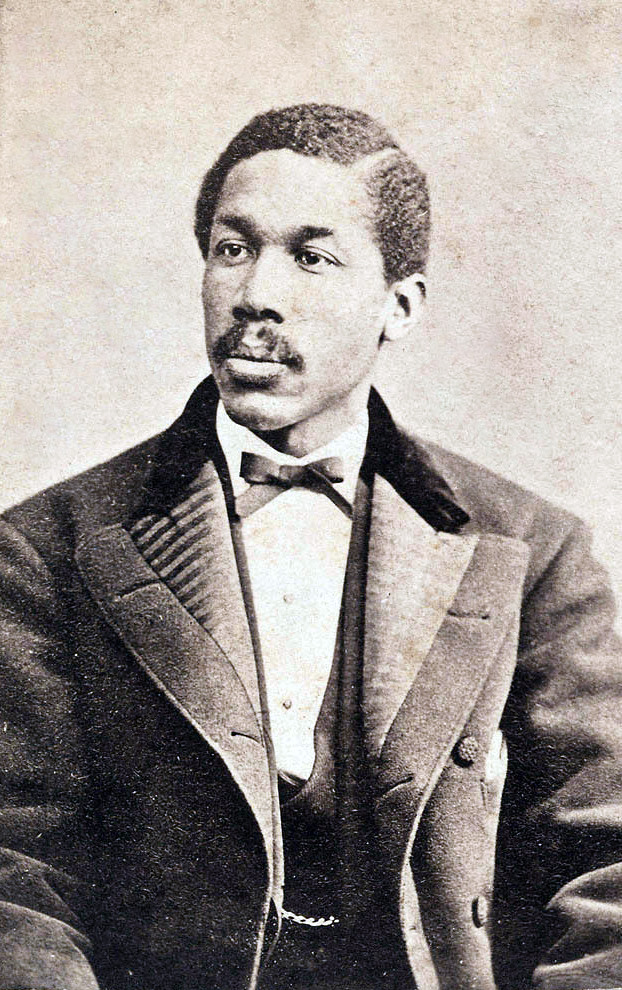
Octavius Catto is another one of those people who fought a good fight for racial equality but never got the name recognition. Apparently Octavius Catto actually shared a stage with famed abolitionist Frederick Douglas and apparently "electrified" the crowd. He worked for integration in everything from baseball to street cars and actually even wrote a book on it. He was actually even killed for his work trying to encourage black voter participation in the 1971 election because the Irish Democratic machine didn't like blacks, especially blacks voting GOP to get a chance.
Picture from http://en.wikipedia.org/wiki/File:Octavius_Catto.jpg
Picture from http://en.wikipedia.org/wiki/File:Octavius_Catto.jpg

Friday, March 18, 2011
7th Avenue and the Delaney's
I think it is really fitting how the Delaney's went from their small town roots to one of the most active and famous streets in one of New York's most well-known neighborhoods. 7th Avenue, home of both the Delaney family apartment and Bessie's dental practice overlooked the center of black culture and developments of the day. Just from looking out the windows they would have seen a wide variety of the churches, clubs and distinguished citizens of Harlem. They were in the center of it all. I can see why Bessie had her office where she did (besides being near family) it was a bustling place and she was right in the middle of the action.
Saturday, March 5, 2011
Burden of slavery

In the same way the color of their sin chained blacks to slavery before the Civil war, the color of their skin also chained blacks after the war and their "freeing." Even though Sadie and Bessie are free from the physical chains of slavery and its horrors, they are both still black and to other people they are inferior and second class and fair game. They are, in a sense, chained to their skin color and the discrimination that comes with it- they still have the weight, per se, of color/race warfare on themselves, like in this illustration where this slave is both figuratively and literally forced to bear the weight of the slave ship and slavery. This slave, like Sadie and Bessie, had no choice in the matter and were forced to go through with life chained to the idea that they were second class citizens.
http://www.tfaoi.com/am/10am/10am96.jpg

Saturday, February 26, 2011
Hard work beats talent when talent doesn't work hard--Having my say
I think it's interesting the value our culture puts on talented people over hardworking people. The stereotype is that people who are naturally talented (or smart or gifted or whatever) are prized more highly than people who actually built themselves via working hard for it. But, in comparison, I read an interesting piece somewhere about how highly ranked Presidents like Reagan and Lincoln are, who were working class people for much of their lives and don't have an Ivy League education, and are generally ranked higher than many Presidents who were born with a silver spoon in their mouthes. I know there are a whole bunch of exceptions but it still really seems that way, especially for such an elite group. You can see that in a lot of people too, a big difference in the mannerisms of people who recieved what they have versus the people who have had to earn what they have. You can really respect people for the work they have done. Just wanted to have my say.
Wednesday, February 16, 2011
Whitman poem reflection
The thing I really got from the poem was about how each little (or big) thing the boy encountered became part of him, he learned from it. He was built by the things he saw and felt and experienced, which is something we all should always be doing, like in the Scarlet Letter, gainig wisdom and knowledge through or lives and experiences and even sufferings.

Friday, February 11, 2011
She hasn't told her garden yet
I haven't told my garden yet --
Lest that should conquer me.
I haven't quite the strength now
To break it to the Bee --

I will not name it in the street
For shops would stare at me --
That one so shy -- so ignorant
Should have the face to die.

The hillsides must not know it --
Where I have rambled so --
Nor tell the loving forests
The day that I shall go --

Nor lisp it at the table --
Nor heedless by the way
Hint that within the Riddle
One will walk today --
When Emily writes here she is hinting toward her upcoming death, one of her favorite topics. It would only be natural for her to inform her garden, seeing as she was said to be a "gardener first and a poet second." She apparently spent a lot of time either working in or enjoying her garden, and amongst her fascination over death, she does not want her garden to know what will one day happen to her, as it has happened to those around her. Here she underlines both her fascination over death and its mystery and her love for all things nature, which would have brought welcome variety to her otherwise simple life.
Friday, February 4, 2011
Transcendentalism over anti-Transcendentalism
I got a lot more out of the Transcendentalist writings. They seem to have a lot more hope and depth to them. As interesting as the anti-transcendentalist ideas are, the connections to nature and hope and life itself are much stronger and we can see a point to it all. Walden, especially, is not a wallow in doubt and self pity, it is about the honesty and beauty and strength shone to us by the world, and allow us to see deeper into nature and into life itself, and more importantly, learn from it. The transcendentalists teach us to look at our lives in perspective and hope and enjoy life, not fear it or waste it. They seem to have faith, whether in God or human nature or nature itself. The anti transcendentalists are in denial.

Tuesday, November 16, 2010
New Ending

I fell forward, feeling the oppression and evil of the pit in front of me, overcome only by my dread of the closing walls, threatening to squeeze all remaining life out of my being. But as I began to make that dreaded tumble to impending death in the pit below, I suddenly found myself immovable in the air, suspended over my death by some unseen force. Suddenly, the three judges reappeared in front of me, as stern and unsmiling as before, though now they all carried a wicked gleam in their eyes, a gleam that drove fear deep into my heart. The judge in the middle pulled off the guise of the white body, underneath appearing a hideous, grotesque, ash-black face with red eyes glaring incessantly at me. I knew from the deep sense of fear that overcame, my shaking, the chills, that this was no judge, but instead and me Lucifer himself. He gave me an appraising smirk and nod. “You have defeated two deaths now, my pit of darkness and pendulum of death. You are too great to perish only by your hand into that pit. You will die, yes, but Satan wishes to give you a choice given to no other man. You may plead acquittal before my brothers [indicating the two flanking judges] and try your luck, (dieing later, of course,) or you may choose to fight the walls. The choice is yours” he leered. Looking from the unflinching faces of the two to the jagged walls of the dungeon, finding myself free to move about, declared “I make my own luck” and dove to my death in the pit, watching the disappointed yet satisfied faces of those above.
Tuesday, November 9, 2010
Iving over Poe

I am more inclined to side with Washington Irving over Edgar Allen Poe because of the sharp contrasts in writing style, because I think Irving writes a better story. Even though Poe has the name recognition and the more famous stories, I like Irving and how he writes. When neither one of them is really crisp and clear, I like how Irving uses action and values and subtle themes. Irving does a good job getting the gothic elements in, but it's not all gothic, there are deeper values and a good, positive ending. Wheras Poe is all dreary and helplessly stuck on punishing his characters and expressing his problems through his writing. Very little, if any, good happens with Poe, when Irving brought a little hope and promise of change, even if it is only a little.
Thursday, November 4, 2010
Reflection on A Psalm of Life
To listern to the music video corresponding to reflection copy and paste address:
http://www.youtube.com/watch?v=oTALLCna6gY">

http://www.youtube.com/watch?v=oTALLCna6gY">

After reflecting on “A psalm of life,” I realized just how similar that poem, written many years ago is similar to a current song we hear a lot of today that echoes many similar themes, “Live like we’re dying” by Kris Allen. You compare them side by side and it is amazing how Longfellow’s words and the values they represent are so timeless. “A psalm of life” is really a deep work that Longfellow obviously thought through deeply, and so is, in a different way, “Live like we’re dying.”
“Sometimes we fall down, can’t get back up/We’re hiding behind skin that’s too tough/How come we don’t say ‘I love you’ enough till its too late” opens Kris Allen, very similar to Longfellow’s beginning of “Tell me not, in mournful numbers,Life is but an empty dream? —For the soul is dead that slumbers,And things are not what they seem.” Both underline the ageless theme of despair and hopelessness that gets in the way of people using their lives to the fullest and focusing on the future and what they can achieve, not selfishly holding onto what they have.
“And we’re all staring down the barrel of a gun/ so with your life that’s before you/ what do you wish you would’ve done” Kris Allen continues, parallel to Longfellow’s verse “Art is long, and Time is fleeting, And our hearts, though stout and brave, Still, like muffled drums, are beating, Funeral marches to the grave.” Both hit on the limited amount of time we have-we are all indefinitely heading to the grave and staring down the barrel of gun, the only question is when.
However, the message is less about death than about using what time we have left. “We only have 86400 seconds in a day to turn it all around or you’ll throw it all away.” “Trust no Future, howe’er pleasant! Let the dead Past bury its dead! Act, --act in the living Present! Heart within, and God o’erhead!” Both of them talk about the sheer importance of action, putting the past behind us where it belongs and looking to the future knowing it is limited. Now is the time, and they know and encourage it.
“Gotta tell them that we love them while we got the chance to say/ Gotta live like we’re dying.” “Lives of great men all remind us, We can make our lives sublime, And, departing, leave behind us, Footprints on the sands of time.” It’s kind of subtle in a sense, but these are both definitely on leaving “footprints on the sands of time”—a legacy that lives after us for us when we no longer can. They both say we need to use our time to further those around us and after us—which is ultimately the focal point for both of these poems.
Both of these works read and listen well lightly, but go much deeper than the surface. Underneath the music and the poetry, there are huge themes. Defeat, death, action and legacy all come up, important things to each and every person. And, after reflecting on it, essential to making our life worth the living.
Thursday, October 28, 2010
Wednesday, October 27, 2010
Voki
<script language="JavaScript" type="text/javascript" src="http://vhss-d.oddcast.com/voki_embed_functions.php%22%3E%3C/script%3E%3Cscript language="JavaScript" type="text/javascript">AC_Voki_Embed(300, 400, '7d71896134ed29c2424354a48ff9d7a5', 2946761, 1,'', 0);</script>
Reflection on nature- fall.
Fall is really a time of transition. You are between the heat and sun of summer and the cold and snow and winter. You can have a fall day that is freezing or an Indian summer of the seventies or eighties, sometimes in the same day. The leaves turn colors but then they fall off and the trees are bare. You know it is going to be cold soon, but it isn’t yet, and you have a chance to reflect on your summer and look to the upcoming cold and new year. Fall is a time of transition.
Friday, October 15, 2010
Hollywood begins the Red Scare

http://www.youtube.com/watch?v=LfKSykTPzA4&feature=player_embedded
This video is an interesting preface to the modern-day Salem--Hollywood during the Red Scare. When you just listen to this video it makes it sound like this is a tame search for a few Communists based on evidence, not the witch-hunt it became. And the bit from the producer too makes it seem like this will be peaceful. The producer makes it sound like Communism is not a problem and is not tolerated, which directly debates the amount of people that actually were charged, guilty or not. The website I checked said that about 350 people from Hollywood were punished, either jail time for contempt of Congress or told not to work for the entertainment industry. Whether they were actually Communists or not (a few probably were) that is a huge number for the amount of real evidence.
I really get a kick out of how tame and well-meaning this video talks about or implies the search will be and that the guilds actually claimed also to be anti-Communist and willing to do their part. How quickly things changed.
http://www.spartacus.schoolnet.co.uk/USAhuac.htm
Thursday, October 7, 2010
The Crucible, Act 1

This first act of The Crucible shows just how pent up with anger these people are, that when given the chance they will use the situation to settle personal grudges with other people they dislike. It really seems like these are the exact opposite of an ideal Puritan settlement, they are all running around wrongfully accusing each other just because they don't like something about the other, and have no problem seeing their neighbor tried or hung because they have an argument or different view. And in amongst all of this witch-calling are land disputes, money disputes, sect rivalries and affairs. When you think of an ideal Puritan village you would think they would have respect for one another and not be involved in all of these things, but I guess they had enough. They're not perfect, after all. There's only so much anyone, even the religious, can take.
Wednesday, September 29, 2010
King Philips War Account by Colonist
 "We have fought the devil and is ways in flesh and blood form. We weare engaged in a deadly conflict with Metacom (King Philip) who was commanded by Satan to destroy us. It began when we, as responsible Christians, sought to bring religion to the natives and draw them away from their foolishness. We had established prayer towns and places where Natives could come and learn our religion and culture, hoping to bring Christ to them in that way. However the Devil through the errant beliefs of the natives caused Metacom to want to attack us. When we were warned of his intents, the messenger was murdured. After we sought justice for this death by hanging some of Metacom's followers they became even more violent. Over time they attacked many settlements and killed many of our number before Metacom was finally killed in hiding by our raiding party, for many of his allies had joined our side. Let this be noted by all: This was a message to us from God. We must stand up and fight the evil of this world, resist it, for it seeks to destroy us. We must fight through the difficulties we face for in the end we know God will help us defeat all of our enemies who resist the Lord and his message and will." -Average Colonist of the day
http://en.wikipedia.org/wiki/King_Philip's_War
http://imagecache6.allposters.com/LRG/22/2246/3K2ZD00Z.jpg
Wednesday, September 22, 2010
William Brewster-week 3
William Brewster was born around 1566 in Doncaster, Yorkshire, England. He went to Cambridge for a while, but never got a degree. He eventually worked under William Davison, the Secretary of State. He later took over his father’s position as local postmaster. He helped to start a Separatist church and after its move to Amsterdam and then Leiden (both Holland). During his time in Holland he helped to publish anti-Anglican church literature, almost to the point of being arrested. When part of his congregation decided to travel to America, he was asked to go along with his family and serve as a religious advisor. When they arrived he became the senior elder of the colony and a close advisor to the governor, William Bradford. Being the only pilgrim university educated, he served as religious leader for several years until their official pastor arrived. For his service Brewster received some of the islands of Boston harbor, which still bear his name.
William Brewster had several large contributions to the colony. During his tenure he served as religious leader he probably helped to remind the colonists why they were there and given them support. He was also an advisor to William Bradford and was part of the main decision-makers. He bore responsibility for the religious life, which was quite a task during all of the hardships they faced. After his death in 1644, Bradford wrote of Brewster as being "sociable and pleasant amongst his friends, of a humble and modest mind, and tenderhearted and compassionate."

Subscribe to:
Posts (Atom)